
Credit Utilization Explained: The Fastest Way to Improve Your Credit Score
How much of your available credit you use is one of the biggest factors in your credit score, and one of the quickest to change. Learn how utilization is calculated and how to lower it.
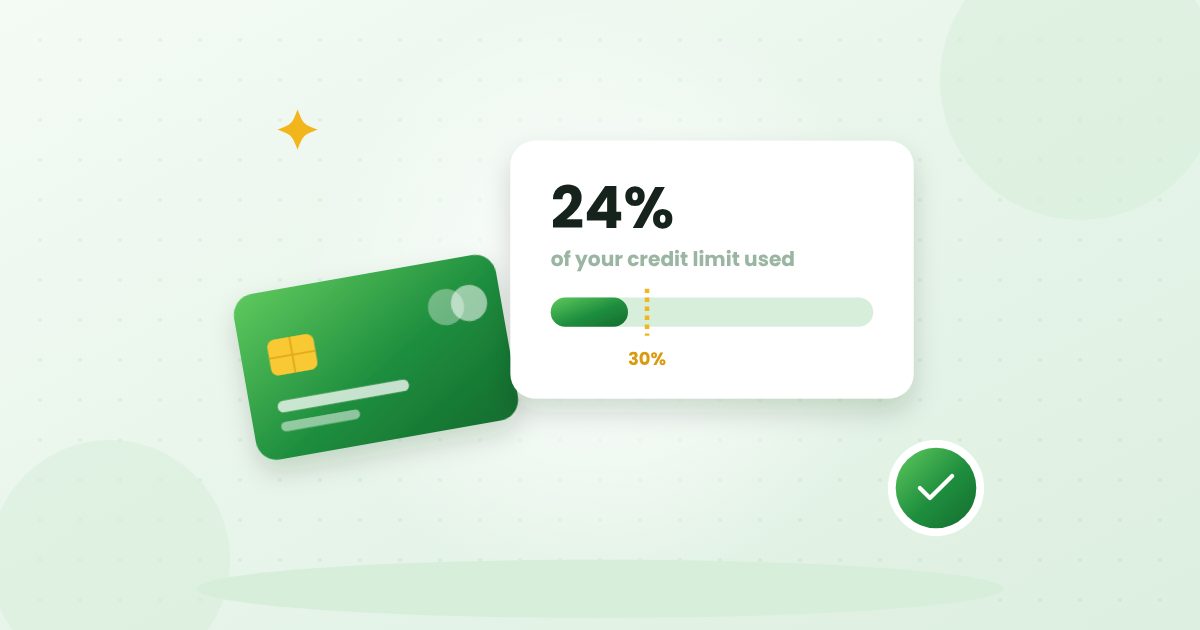
Payment history matters most for your credit score, but credit utilization comes close, and unlike a late payment from years ago, you can change it in a single month. If you want to improve your score quickly, this is often the best place to start.
What is credit utilization?
Credit utilization is the share of your available revolving credit, mainly credit cards, that you are using.
Utilization = total credit card balances ÷ total credit limits × 100
Example
| Card | Balance | Limit |
|---|---|---|
| Card A | $900 | $3,000 |
| Card B | $300 | $2,000 |
| Total | $1,200 | $5,000 |
Overall utilization = $1,200 ÷ $5,000 = 24%
Scoring models look at both your overall utilization and the utilization on each card. Here, Card A is at 30% and Card B is at 15%. Our percentage calculator makes these numbers easy to work out.
What is a good utilization rate?
There is no official cutoff, but common guidance is:
- Under 30%: generally considered acceptable
- Under 10%: often associated with the highest scores
- 0% on every card: can be slightly worse than a small balance on one card in some scoring models, because it shows no recent use
Lower is generally better, but you do not need to obsess over a single percentage point.
Why it affects your score so much
Credit scores try to predict how likely you are to fall behind on payments. Using a large share of your available credit can signal financial stress, so higher utilization usually means a lower score. In the FICO scoring model, amounts owed, which includes utilization, is one of the largest factors. See how credit scores work.
The good news: it has no long memory
In most widely used scoring models, utilization is calculated from your most recently reported balances. When your balances drop and the new balances are reported, your score can improve quickly, often within one or two billing cycles.
When your balance gets reported
Card issuers usually report your balance to the credit bureaus around your statement closing date, not your payment due date. That means even if you pay in full every month, a large balance on your statement can show high utilization.
Tip: if you are about to apply for a loan, pay down your card before the statement closes so a lower balance gets reported.
7 ways to lower your utilization
- Pay down balances. The most direct method. Focus on cards with the highest utilization or highest interest. See debt snowball vs. avalanche and our credit card payoff calculator.
- Pay twice a month. Paying mid-cycle keeps the reported balance lower.
- Ask for a credit limit increase. A higher limit with the same balance lowers utilization. Ask whether it requires a hard inquiry first.
- Keep old cards open, especially those with no annual fee, so you keep their limits.
- Spread spending across cards so no single card is close to its limit.
- Consider a balance transfer to pay debt down faster at a lower rate. Read balance transfer cards explained.
- Avoid maxing out a card, even if you plan to pay it off.
Mistakes to avoid
- Closing a paid-off card right before applying for a mortgage or car loan
- Opening several new cards just to raise your total limit, which adds hard inquiries
- Thinking you must carry a balance to build credit. You do not need to pay interest to have a good score.
Frequently asked questions
Does utilization include loans?
Utilization mainly looks at revolving credit like credit cards. Installment loans, such as car loans and mortgages, are considered differently.
Does a credit limit increase hurt my score?
Some issuers do a soft inquiry, which does not affect your score; others may do a hard inquiry. Ask before you request one.
How fast will my score improve?
Often within one or two months after lower balances are reported, but every credit file is different.
Spotted an error? Tell us and we will review it under our editorial policy.


